...at your own pace from the comfort of your home for a fraction of the cost of attending an expensive university class.
"I enjoyed the presentation and appreciate Bart's insistence of sticking to the facts as well as pointing out the bias in later presentations of the relationship. From a techinical, geek, perspective the edits were not obvious and the transitions were smooth. Overall, the content and the presentation were up to the bar you (plural) set for yourself."
"Bart is the best communicator on the topic of historical Christianity I’ve ever heard. His depth of Bible knowledge is truly impressive. His insights are remarkable regarding the dangers of Christian zealotry and yet he is not out to “trash” Christianity, rather he has a sympathetic understanding of people’s need to cling to something that seems to give them meaning, regardless of being historically indefensible."
"Like many, I grew up in church and was quite devoted. But, honestly I never truly read the Bible. What I have learned through this course lifted a veil. This course and the many episodes of this podcast and have fully answered so many questions that I have had since I left the church 30 years ago. Thank you for this material and for sharing the scholarly knowledge I would otherwise not get. "
"Aut dicta commodi nostrum quidem delectus molestiae ad et ex odit."
- If, as scholars maintain, Matthew used the Gospel of Mark as one of his sources, why did he change it so extensively?
- Why does Matthew provide a genealogical line of Jesus that he is explicitly said not to be born into?
- Does Matthew sometimes misquote the Old Testament or take it out of context in his attempt to prove that Jesus was the messiah?
- How are we to understand the Sermon on the Mount? Does Jesus really expect his followers to keep such rigorous teachings? Not ever to get angry? Never to lust?
- Matthew is often said to be the “most Jewish” of the Gospels. It is also often described as virulently anti-Jewish. How can it be both?
- How was this Gospel used over the years both to shape Christian morality and to instigate horrible persecutions of Jews? Are there right and wrong ways to read this influential book?
Sneak Peek Inside the Course:
- ($24.95 Value) Lesson 1: How Do You Study a Gospel?After a brief overview of the Gospel of Matthew – its contents, date, language, author, and sources of information -- this lecture will discuss various ways people approach the Gospels of the New Testament. Many readers read them devotionally, to provide insight and guidance for the faith and lives; some look at them as literary works to be studied for their themes and overarching portrayals of Jesus; others approach them as historical sources for trying to understand what Jesus really said and did. I will discuss and evaluate each of these approaches before introducing yet another way to read the Gospel of Matthew, one rarely undertaken by laypeople but used all the time by scholars. This approach takes seriously the fact (which appears to be a fact) that Matthew used one of the other Gospels as one of his sources of information. If so, how can we examine Matthew in light of the changes he made to Mark, adding stories Mark does not have, omitting things Mark does have, and altering nearly all of the ones he borrowed so as to put a different spin on them. How do these various changes help us understand Matthew’s distinctive portrayal of Jesus? The results in fact are highly enlightening, as we will see throughout the course.
- ($24.95 Value) Lesson 2: Jesus and Ancestors.comGenealogies are among the least enjoyed parts of the Bible for most readers. Many students are virtually allergic to them. But Matthew should be a major exception. The first eighteen verses present a genealogy (not in Mark) of Jesus that is full of puzzles, overlooked by, well, everyone who skips this bit or just speeds over it. That’s too bad. A full analysis of just these verses could be an entire course, and, surprisingly enough, a really interesting one! In this lecture, we will consider many of these issues. Why, for example, if ancient Jewish genealogies are patrilinear (as they are, tracing lineage from father to son), are there four women mentioned in this one (in addition to Mary)? And why are all of these alleged ancestors of Jesus best known for their extra-marital sexual experiences? Even more curious, if this is a genealogy of Jesus, why is Jesus explicitly said not to belong to it? The genealogy is explicit of Mary’s husband Joseph, who is not Jesus’ father! So what’s the point? Moreover, Matthew structures the genealogy to suggest that God has foreordained Jesus himself to be the messiah, claiming that fourteen generations separated the first ancestor mentioned, Abraham, the father of the Jews, from David, the greatest king of the Jews; and that fourteen generations separated David from the last of his descendants on the Judean throne; and that fourteen generations then separated the last descendant on the Judean throne and Jesus himself, the messiah. Now that is an amazing coincidence. But does it work? Does the genealogy actually contradict the Old Testament? And just as puzzling, why in the final sequence of fourteen generations are there, in fact, only thirteen?
- ($24.95 Value) Lesson 3: The Gospel in a NutshellUnlike Mark, Matthew provides an account of Jesus’ birth. In this course, we will not be comparing his account with the very different version in Luke or discussing its historical puzzles and problems, as I’ve done in other courses. Instead, we will focus on a particularly intriguing issue of vital importance for understanding the entire Gospel. As on other occasions in his Gospel, Matthew, unlike Mark, explicitly indicates that what happened to Jesus was precisely to “fulfill what was spoken” by Old Testament prophet. That is why, for Matthew, he was born of a virgin, in Bethlehem, leading to Herod’s “slaughter of the Egypt,” the “flight to Egypt,” and his resettlement then in Nazareth-- all because one or another prophet said it would happen. In each case, Matthew quotes the Scriptural passage (Isaiah, Micah, Jeremiah, etc.) to prove his point. These are absent not only from Mark but from all the other Gospels. Scholars call these quotations “fulfillment citations,” and on the surface, they seem straightforward, but they are anything but that. What does Matthew actually mean that Jesus “fulfilled” these Scriptures? In their original contexts were they given as predictions about the future messiah? Do they refer to a messiah at all? Is Matthew playing fast and loose with the Scriptures in order to make a point? Or is he using established Jewish modes of interpretation – reading these texts in ways that readers simply don’t read books anymore? And – to pick just one of the odd problems -- why is one of these quotations not found anywhere in the Old Testament?
- ($24.95 Value) Lesson 4: The Sermon on the MountNo part of Matthew is more famous than the Sermon on the Mount (chapters 3-5), a sermon not found in Mark and, in fact, any of the other Gospels. Here we have the famous beatitudes (“Blessed are the poor in spirit…”), the antitheses (“You have heard it said, do not murder, but I say to you….), the Lord’s prayer (“Our father…”), the golden rule (“Do unto others…”), and many of Jesus’ most famous pithy sayings, often just one-liners (“No one can serve two masters…”). Many readers have not noticed, however, how Matthew is using this sermon to say something about Jesus again as a “fulfillment” of Scripture, but in a far more subtle way than in the fulfillment citations. Matthew portrays Jesus as the New Moses who comes to give the New Law of God to his people. But in doing so, is Jesus lambasting Moses himself? Or subordinating him to himself? Or superseding him? And what does his connecting Jesus and Moses say about Matthew’s understanding of the Jewish religion? Are Jesus’ followers to keep its laws as well as those of Jesus? The answer, as it turns out, is not at all obvious. Not only does the sermon need to be understood in relation to Moses but also in relation to Jesus’ and Matthew’s own apocalyptic context. In this lecture we will explore the world of Jewish apocalypticism and see how it is crucial to unpacking some of the most familiar passages of the Sermon on the Mount.
- ($24.95 Value) Lesson 5: The Ambiguity of MatthewNear the beginning of the Sermon on the Mount is a passage many readers appear not to notice, in which Jesus emphatically states he does not reject the Jewish law and that his followers need to keep it even more assiduously than the most devout Jewish leaders. Really? Christians throughout the centuries have usually argued that Jesus came to get rid of the law. In another passage later in Matthew Jesus is even more explicit: he tells his disciples they are not to ignore the teaching of the Pharisees but to keep them to a “T”. The problem with the Pharisees is not that they are too scrupulous in keeping the law, or that their teachings embody a false understanding of what God wants. The problem is they don’t practice what they preach. The disciples of Jesus are to follow what the Pharisees preach. I never heard that in Sunday School! And it certainly is not what you find in most of the rest of the New Testament. Is Matthew at odds with the other Gospels on this point? With the teachings of Paul? With the entire Christian tradition? Have readers simply assumed that Matthew held a view like all the others, that with the coming of Jesus, there was no longer a need to keep the law? To make matters more perplexing, if Matthew is so thoroughly behind the Jewish religion, why does it also seem to be so “anti-Jewish,” with attacks not only on Jewish leaders but, apparently, on the Jewish people themselves? Is he Jewish or anti-Jewish?
- ($24.95 Value) Lesson 6: The Ultimate PointIn many ways, despite the puzzles, quandaries, and difficulties of Matthew’s Gospel, the overarching message is clear. This is a book about the birth, life, death, and resurrection of the Jewish messiah Jesus, sent from the Jewish God; to the Jewish people, in fulfillment of the Jewish law. Jesus himself is thoroughly Jewish, his followers are Jewish, he teaches them his understanding of the Jewish law, and he expects his followers to keep it. But most readers of the Gospel, from ancient times until now, have been gentiles. And the Gospel itself appears to anticipate that: the accounts end after the resurrection with Jesus giving his final instructions to his disciples to go take his message now to “all the nations,” that is, “the Gentiles.” But if his followers are to keep the laws of Moses, does he expect these gentile converts to become Jews? One option we will be exploring is that the audience Matthew composed his book for – those in his own community -- may not have been Jews at all (either by birth or conversion). And that Matthew is subtly explaining to them that fulfilling the law better than the scribes and Pharisees does not require converting to Judaism. In this lecture, we address these questions and show how Matthew foreshadows that view at the very beginning of the Gospel, in a familiar passage that almost no one suspects to embody the main message of the entire book: the visit of the wisemen to worship the baby Jesus.
- ($24.95 Value) Lesson 7: Who Was Matthew?In this lecture, we take a step back from our literary analysis of the first canonical Gospel to consider at length what we can say about its author. We call him, of course, Matthew, and by that we mean the tax collector Jesus called to be his disciple in chapter 9, but who is not identified as the author of the book either in this passage or any other. It would obviously matter a great deal if one of Jesus’ own disciples actually did write the book. Then we would have a first-hand, eyewitness account of what Jesus said and did, and not from a distant observer but with someone who spent virtually his entire ministry with him, day and night. But why doesn’t the author name himself? Did he put a title on the book indicating he was the author? If not, why should we think that the book was written by Matthew the tax collector in particular? Are there clues in the text itself, intimations of whether this author was a companion or a tax collector? It is widely said that Matthew is identified by the author already in the early second century, in a statement of an early Christian writer named Papias writing around 120-130 CE. Would that be compelling evidence? Many questions can be asked: how, for example, would someone living in a different part of the world 40-50 years later know who had written it if it were circulating anonymously? In addition, we have other comments from Papias that have been preserved: is he generally thought to be a reliable source of information? And when he says that Matthew wrote the Gospel, how do we know that he is talking about the same book we read today? Do our surviving manuscripts help us know if Matthew wrote it? What about their titles? In the end, what is the most probable conclusion: who wrote this book?
- ($24.95 Value) Lesson 8: The Afterlife of MatthewThe Gospel of Matthew played a significant role in the development of early Christianity; it was quoted extensively by church fathers; it was eventually placed into the canon of Scripture; and later scribes sometimes modified its text both accidentally and, in some cases, apparently, intentionally. In this lecture, we consider the afterlife of the Gospel to consider how it came to shape not just the Christian understanding of Jesus but also the understanding of what it really meant to be his follower. We’ll also consider how the distinctive emphases of Matthew came to be so often overlooked and /or harmonized by readers who wanted to harmonize its views with the other Gospels and Paul. In addition, we will examine how the book came to be used in Jewish-Christian dialogue, and how over time it came to be used as a divine sanction for anti-Jewish sentiment and, eventually serious violence. Of less social and political importance, but still unusually interesting (and virtually unknown), is the fate of the Gospel in the hands of scribes. We will consider how individual scribes altered the text, and why, and we consider several rather surprising scholarly proposals that the original form of the Gospel did not originally have the first two chapters (that is, the genealogy and fifth narrative) or the final two verses (Jesus’ Great Commission that is often taken to include a reference to the Trinity). Can these views be right?
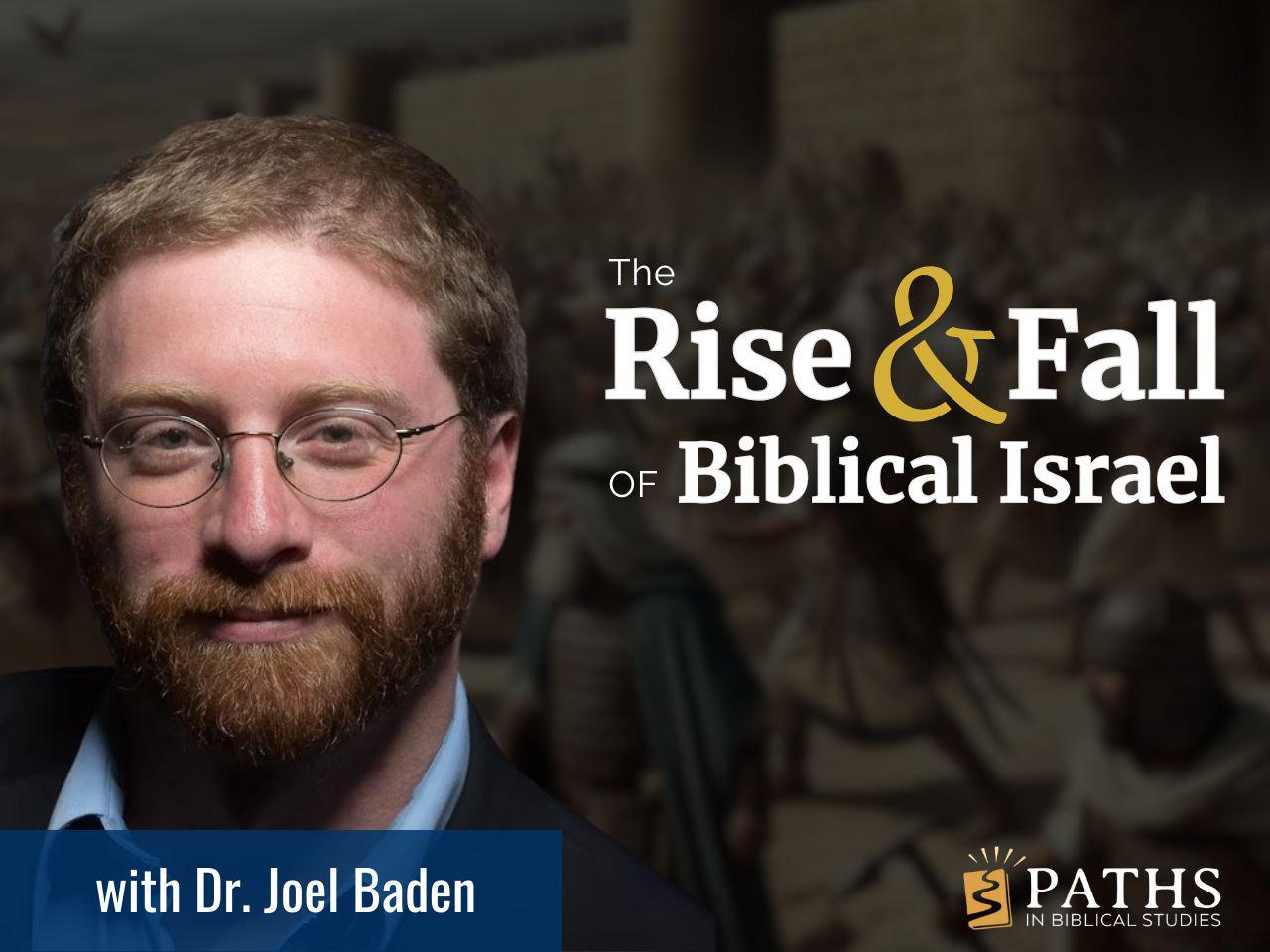
Enroll in "Rise and Fall of Biblical Israel" Today
$444.55 Value for only $29.97.
In-Depth, University-Level Lessons PLUS... $244.95 of Bonus Materials
Bonus #1 - Comprehensive Resources Pack
Text Overviews, Printable PDFs, and Deep-Dive Questions
Take your learning experience to the next level with our Comprehensive Course Resources Pack. This invaluable resource includes:
- Text Overviews of Each Lesson: Get a clear and concise introduction to the topics covered in each lecture. Perfect for refreshing your memory or previewing what’s ahead.
- Printable PDFs with Note-Taking Space: Keep track of important points, reflections, and insights during the course.
- Thought-Provoking Reflection Questions: Dive deeper into the material with prompts that encourage critical thinking.
This Course Resources Pack is your personal guide to mastering the material, ensuring you stay engaged and never miss a key insight.
Bonus #2 - Exclusive Q&A Sessions
Experience 60 Minutes of Live Q&A
Gain extra insights with our Exclusive Q&A Sessions. After each lecture, Bart Ehrman answers participant questions, adding clarity and depth to the course material. These Q&A sessions bring the dynamic, live experience to you, allowing you to explore topics in greater detail.
This bonus offers a closer look at Bart’s expert responses to real questions, enriching your understanding and making your learning more interactive.
Bonus #3 - Audio Downloads
Audio Lessons for On-the-Go Learning
Enjoy the flexibility of learning wherever you are with our Audio Downloads. Perfect for listening while in the car, working out, or anytime you're on the move. Each lecture is available as an audio file, making it easy to continue your education no matter where life takes you.
Bonus #4 - FREE Lecture from "Lukes Maverick Gospel"
Bonus #5 - Self-Assessment Quiz
Bonus #6 - Downloadable eBook
- 01Customer
- 02Payment
Join The Rise and Fall of Biblical Israel Today!
## Contact information
## Billing address
## Step 2: Enter Your Payment!
You will not be charged for this purchase, but if you choose to make an optional purchase later, this card info will be used to complete that transaction!
Completing payment with PayPal
- Total payment
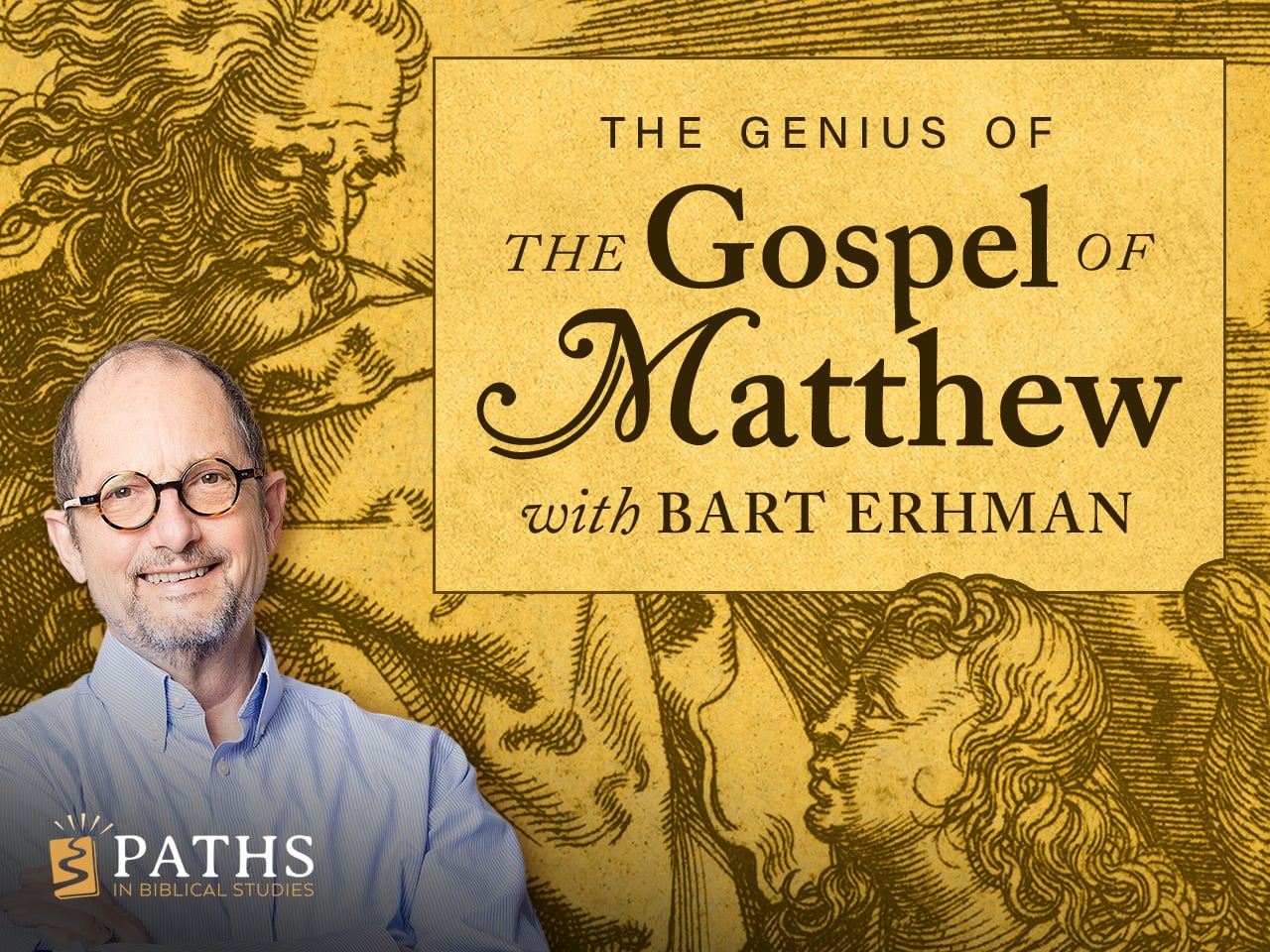
- The Genius of the Gospel of Matthew$59.95
Frequently Asked Questions
Is this a Live Course? Bart gave the lectures and recorded them for a live audience, so there is no live component to this course. However, you will receive advanced notification and discounts to Bart's future live events. In addition, included in this purchase is Lifetime Access to the Online Course.
Enter your bullet points here..
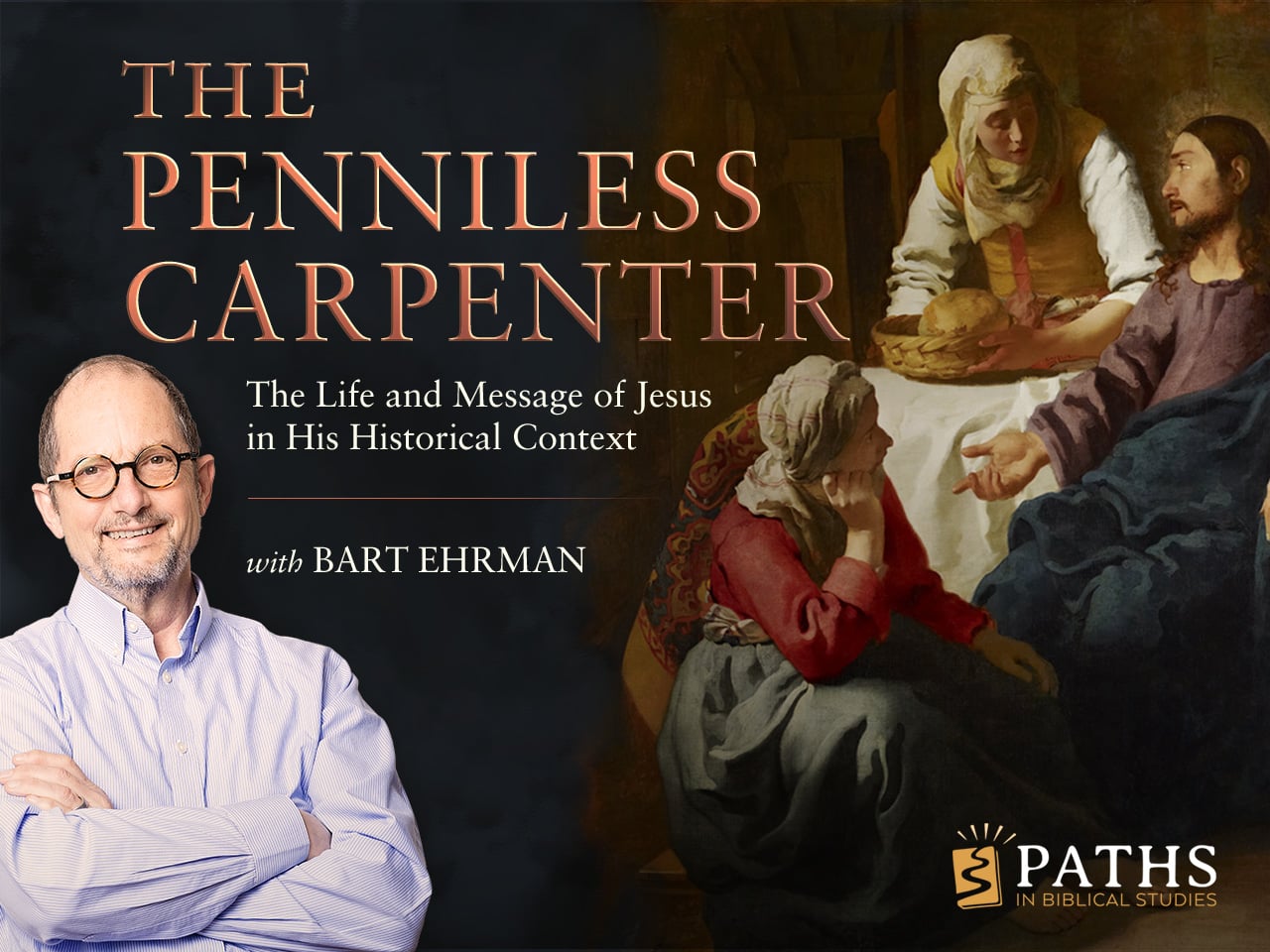
Who is Bart Ehrman?Bart D. Ehrman is a professor of religious studies at the University of North Carolina. He has written or edited thirty-four books, including six New York Times bestsellers: How Jesus Became God, Misquoting Jesus, Jesus Interrupted, and Forged.
Enter your bullet points here..
How did you calculate the value of the course?The value of this course was calculated by comparing it to similar university-level courses. A typical 3-unit college course covering similar material often costs between $3,000 and $6,000, depending on the institution. We estimate the value of the course based on the amount of content, expertise of the instructor, and the depth of the material covered. Additionally, the bonuses included, such as the comprehensive resources pack, exclusive Q&A sessions, audio lessons, a free bonus lecture, quizzes, and eBook add significant value, bringing the total estimated value to $444.55. But you can get it for only $29.97.
Enter your bullet points here..
Where can I watch the course?You can watch the course on any device with internet access, including your phone, tablet, or computer. Our courses are hosted on ThriveCart, a secure and user-friendly course platform, ensuring you have a smooth and enjoyable learning experience on any device.
Enter your bullet points here..
Do you offer a money-back guarantee?Absolutely! If you don't love the course, send us an email to support@bartehrman.com and we will refund 100% of your investment. You will have 30 days from the date of purchase.
Enter your bullet points here..
COPYRIGHT 2024. BART EHRMAN PROFESSIONAL SERVICES LLC